The pursuit of
perfection.

- 70-200mmZoom Range
- f/2.8Fast Constant Aperture
- Lightest in
Class26% Lighter than
Previous Generation1 - Ultra-fast
Focus Silky Swift Voice Coil
AF Motor - Z MountFull-frame/FX
Format




Shot on the NIKKOR Z
70-200mm f/2.8 VR S II
















Built for professionals.
Sharp, in-focus shots, time
after time after time.
Designed for hybrid shooting.
Truly inspiring image quality.
Sharpness and softness in perfect harmony.
viewer in.
Light, compact, refined.
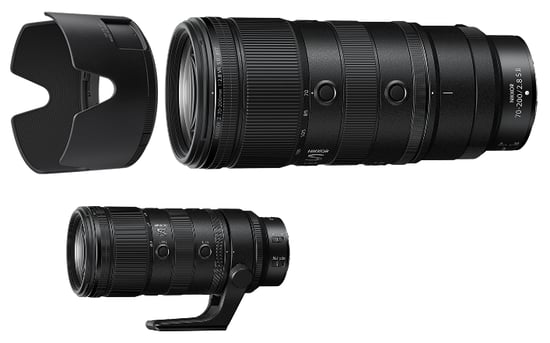
Upgraded in every way.
| Lens Features |
Nikkor Z
|
Nikkor Z
|
|---|---|---|
Zoom Mechanism |
Internal | Internal |
Weight |
2.2 lbs (998 g) Without Foot & Collar | 3 lbs (1.36 kg) Without Foot |
Dimensions |
Approx. 3.6 in. (d) x 8.2 in. (l) (90 mm x 208 mm) | Approx. 3.6 in. (d) x 8.7 in. (l) (89 mm x 220 mm) |
Filter Size |
77mm | 77mm |
AF Drive System |
Silky Swift Voice Coil Motor | STM Stepping Motor |
AF Drive Noise |
Functionally Silent | Virtually Eliminated |
AF Precision |
17.5x More Precise | High Accuracy |
Minimum Focus Distance (70mm) |
15 inches (0.38 m) | 19.7 inches (0.5 m) |
Minimum Focus Distance (200mm) |
31 inches (0.8 m) | 39 inches (1 m) |
Max Magnification |
0.25X (at 200mm) 0.3X (at 70mm) |
0.20X (at 70mm or 200mm) |
Control Ring |
Click/Clickless | Clickless |
Focus Limit Switch |
Yes | Yes |
Diaphragm Blades |
11 (Rounded) | 9 (Rounded) |
Anti-Reflective Coatings |
Meso Amorphous + ARNEO Coat | Nano Crystal + ARNEO Coat |
Filter Access from Lens Hood |
Yes | No |
Lens Elements |
18 Elements in 16 Groups | 21 Elements in 18 Groups |
L-Fn Buttons |
L-Fn 1 (2), L-Fn 2 (4) | L-Fn 1 (1), L-Fn 2 (4) |
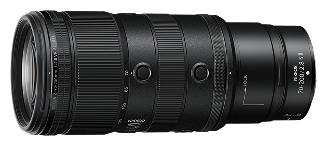
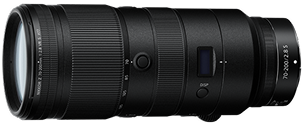
- With tripod collar ring and protective cover removed. Among 70-200mm f/2.8 zoom lenses for mirrorless full-frame mounts, according to Nikon research as of February 23, 2026.
- Complete dust- and drip-resistance is not guaranteed in all situations.
- Compliant with CIPA 2024 standards. Yaw/Pitch/Roll correction performance when attached to the Z6III (at the telephoto end, NORMAL mode). For Synchro VR-compatible cameras, please refer to the support page.
- Depending on the subject, ambient lighting conditions, and the focus point selected, the camera may be unable to focus using autofocus, or the focus indicator for electronic range finding may flicker while a teleconverter is attached.
- This lens’s tripod collar is designed for use with screw-type Arca-Swiss clamps. Lever-type clamps may not provide sufficient holding strength and are not recommended.
Technology

Silky Swift VCM
The Silky Swift VCM is utilized for NIKKOR Z lenses as an AF drive motor. This system simultaneously achieves higher speed, higher accuracy and quieter operation. Each of these factors far surpasses conventional systems, and as for the “quietness” specifically, drive sound is intensively suppressed to an almost-silent level. Even heavy lenses can be controlled accurately at high speed, with minimal noise or vibration, enabling users to reliably capture sharply focused images. Extremely quiet AF operation is specifically advantageous for shooting in places where silence is required and for video recording. WARNING: Do not use this product if you have a pacemaker or other medical device. The magnet or magnets in this product could cause medical devices to malfunction.

Meso Amorphous Coat
Meso Amorphous Coat* realizes the highest anti-reflection performance in NIKKOR history. Meso Amorphous Coat provides an effect superior to that of Nano Crystal Coat for diagonal incident light, and an effect equivalent or superior to ARNEO Coat for vertical incident light. With its superb performance, ghost and flare caused by incident light from various directions are noticeably reduced, delivering clear images even under harsh conditions. *With this coating system, amorphous particles, that are even smaller than nano particles, are utilized to create even more gaps within the coating to form an ultra-fine mesoporous structure, attaining a lower refractive index. In addition, a higher-precision base coat is employed to further enhance the anti-reflection effect.

ARNEO Coat
An anti-reflective coating developed by Nikon and used in conjunction with Nano Crystal Coat to further reduce ghost and flare effects caused by incident light entering the lens vertically. This allows for the outstandingly clear capture of images even when a light source is located within the frame.

Fluorite Lens Element
Fluorite (FL), a lightweight mono-crystal optical material, has excellent optical properties while reducing overall lens weight to improve balance and handling, especially useful in longer focal length lenses.

Fluorine Coat
Photographers need gear that can withstand the elements. Nikon’s fluorine coat effectively repels dust, water droplets, grease or dirt, ensuring easy removal even when they adhere to the lens surface. Nikon’s fluorine coat endures a high frequency of lens surface wiping and its anti-reflective effect also contributes to the capture of clear images.

Short-Wavelength Refractive Lens
SR is a high- and specialized-dispersion glass lens that refracts light with wavelengths shorter than that of blue. By controlling short-wavelength light, the lens is able to achieve highly precise chromatic aberration compensation so that the colors in your images are more accurately reproduced. It also allows for more flexible optical designs, which allows for compact, lighter lenses to be designed.

Vibration Reduction
A Nikon in-lens technology that improves image stability by automatically compensating for camera shake. Lenses that offer VR will feature the abbreviation VR on the lens barrel.

Super ED Glass
Nikon has also developed Super ED glass featuring even lower dispersion properties and extremely high performance in reducing the secondary spectrum, to minimize chromatic aberration even further, as well as other lens aberrations.

ED (Extra-Low Dispersion) Glass
An optical glass developed by Nikon that is used with normal optical glass in telephoto lenses to obtain optimum correction of chromatic aberrations.

Aspherical – Extra-low Dispersion Glass Elements
An ED (Extra-low Dispersion) glass element that features the characteristics of an Aspheric glass element for a more compact size lens. Like Aspherical lenses, AS-ED lens elements minimize coma and other types of lens aberrations, even when used at the widest aperture by continuously changing the refractive index from the center of the lens. The AS-ED lens elements are optical glass developed by Nikon to obtain optimum correction of chromatic aberrations.

Aspherical Lens
A lens with a curved, non-spherical surface. Used to reduce aberrations and enable a more compact lens size. Aspherical lenses minimize coma and other types of lens aberrations, even when used at the widest aperture. They are particularly useful in correcting distortion in wide-angle lenses and help contribute to a lighter, more compact design by reducing the number of standard (spherical) elements necessary. Aspherical lens elements correct these distortions by continuously changing the refractive index from the center of the lens.

IF Lens
A NIKKOR lens in which only the internal lens group shifts during focusing. Thus, IF NIKKORS do not change in size during AF operation, allowing for compact, lightweight lenses capable of closer focusing distances. These lenses will be designated with the abbreviation IF on the lens barrel.

Electromagnetic Diaphragm Mechanism
An electromagnetic diaphragm mechanism in the lens barrel provides highly accurate electronic diaphragm or aperture blade control when using auto exposure during continuous shooting.

A/M
A/M stands for Auto-Priority Manual Mode. This mode also enables an easy transition from autofocus to manual during AF operation. However, mode switch sensitivity has been altered to reduce the possibility of sudden unintentional switching to manual focus while shooting.
Tech Specs

Focal Length Range
70 -200mm
Maximum Aperture
f/2.8Format
FX
VR (Vibration Reduction) Image Stabilization
YesVR (Vibration Reduction) Image Stabilization
Lens-shift Vibration Reduction using a voice coil motor (VCM) Vibration Reduction effect: 6.0 stops (Compliant with the CIPA 2024 standard. Yaw/Pitch/Roll correction performance measured with the Z6III attached (telephoto end, NORMAL mode).
Approx. Dimensions (Diameter x Length)
3.6 in.90 mmx8.2 in.208 mm
Approx. Weight
35.2 oz. (998 g)
- Mount TypeNikon Z Mount
- Focal Length Range70 -200mm
- Zoom Ratio2.9x
- Maximum Aperturef/2.8
- Minimum Aperturef/22
- Aperture Range2.8-22
- FormatFX
- Maximum Angle of View (DX-format)22° 50′ to 8°
- Maximum Angle of View (FX-format)34° 20′ to 12° 20′
- Maximum Reproduction Ratio0.3 x (70mm focal length)x
- Lens Constructions Elements18
- Lens Elements18
- Lens Groups16
- Lens Construction Groups16
- Compatible Format(s)DX, FX
- VR (Vibration Reduction) Image StabilizationYes
- VR (Vibration Reduction) Image StabilizationLens-shift Vibration Reduction using a voice coil motor (VCM) Vibration Reduction effect: 6.0 stops (Compliant with the CIPA 2024 standard. Yaw/Pitch/Roll correction performance measured with the Z6III attached (telephoto end, NORMAL mode).
- Diaphragm Blades11
- Arneo CoatYes
- ED Glass Elements1
- Fluorite Elements1
- SR (Short-Wavelength Refractive) Elements1
- Fluorine CoatYes
- Aspherical Elements2
- AutofocusYes
- Internal FocusingYes
- Minimum Focus Distance70mm zoom position: (1.25 ft) (0.38 m) 85mm zoom position: (1.25 ft) (0.38 m) 105mm zoom position: (1.64 ft) (0.5 m) 135mm zoom position: (1.97 ft) (0.6 m) 200mm zoom position: (2.63 ft) (0.8 m)
- Focus ModeAuto/Manual
- E-typeYes
- Filter Size77mm
- Accepts Filter TypeScrew on
- Approx. Dimensions (Diameter x Length)3.6 in.90 mmx8.2 in.208 mm
- Approx. Weight35.2 oz. (998 g)
- Lens TypeZoom
MTF Charts
Lens Construction
Product Forum
Support
Product Registration
Registering your Nikon product allows us to send you (with your permission) important updates, service information and helpful hints, and it makes it easier should you ever need to call in for help.
Register your product online now.Nikon Answers Site
We store all resolved problems in our solution database. If you can’t find a relevant answer, feel free to submit a question to our technical support team.
View Questions & Answers