5 Tips for Photographing Pets This Holiday Season
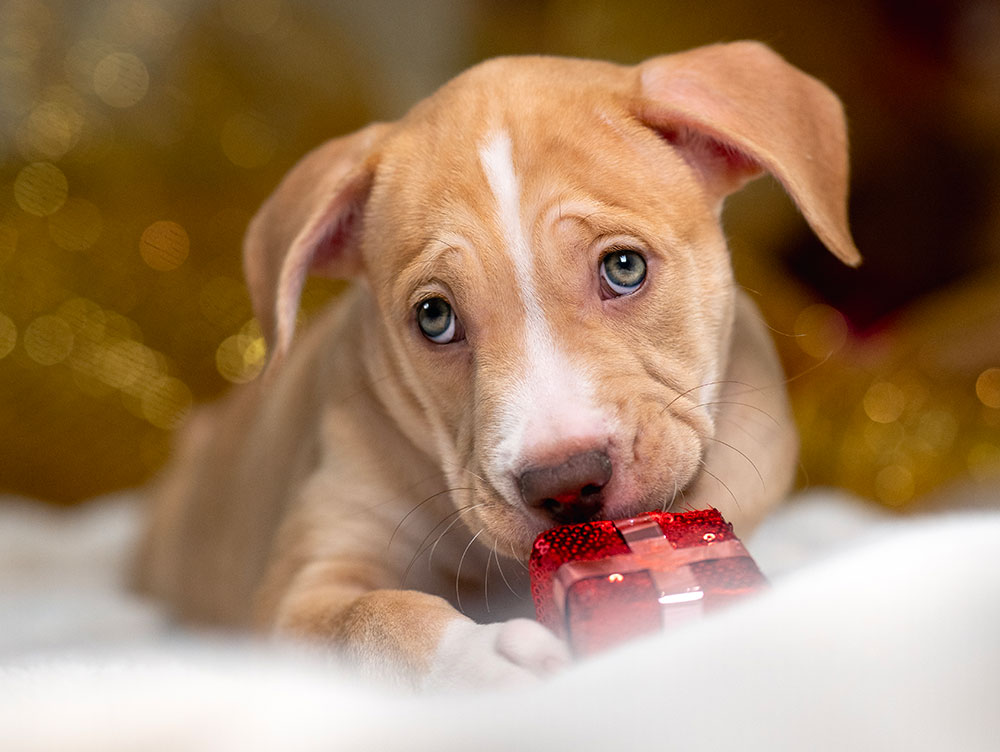
Getting down close to the blanket softened the foreground and brought me right into the puppy’s space. Shooting at an extremely shallow depth of field made the sparkle of the background blur into soft circles of light while using a large continuous light source for these portraits also let me see how the light fell across the puppy’s face as they moved, so I could adjust as needed.
Holiday pet portraits can be wonderfully fun to create, especially when your subjects have absolutely no interest in following your carefully thought-out plans.
I usually begin with a plan for my lighting, background, and composition. Of course, the pet I'm photographing often has quite a few ideas of their own, which is usually when things get most interesting.
The more I photograph cats and dogs (and other animals), the more I appreciate what happens when I slow down and really pay attention. A tiny shift in expression can tell you they're curious, getting tired, or about to do something funny. And being ready for whatever happens next can mean the difference between missing a wonderful moment and capturing one you'll treasure for years to come.
Here are five tips for capturing holiday portraits that show off your pet's personality, whether they're enthusiastically participating or simply tolerating the entire experience.
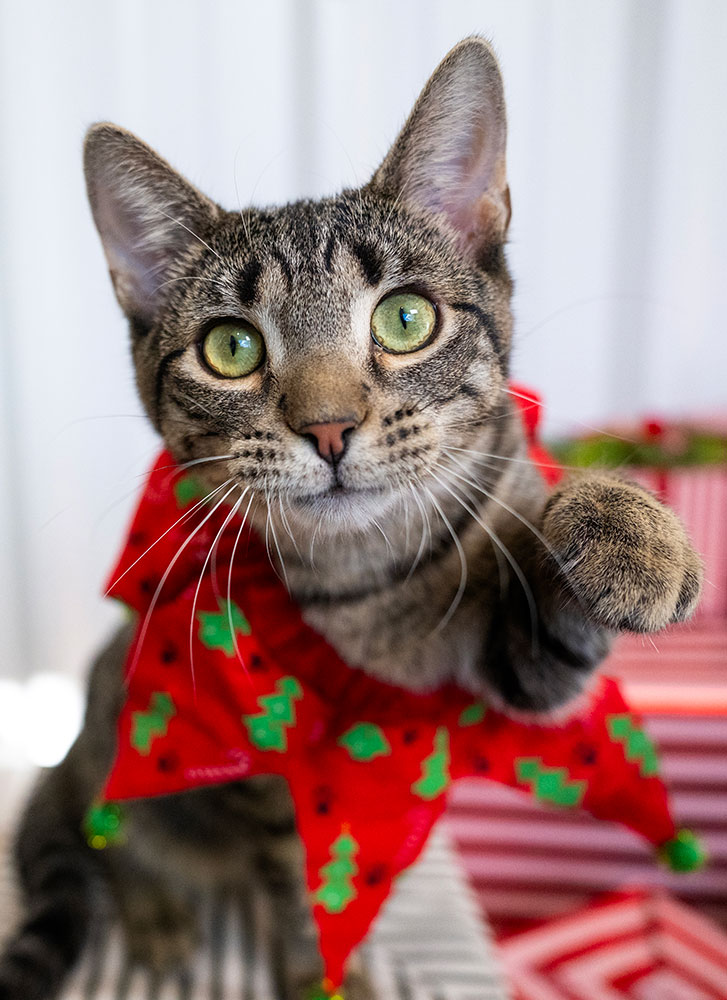
That paw is the whole photograph for me! If your pets starts to reach for you, use a fast shutter speed and shoot a short burst. Make sure to keep the focus on the eyes so the expression stays sharp even as the paw comes forward.
Adjust your lighting or angle, not your pet
I prefer soft, even lighting when photographing animals, largely because I never know exactly where my subject might move next. But even more important to me is capturing catchlights in their eyes. Just as with photographing people, those little reflections of light (also called specular highlights) can make an enormous difference in how we connect with a subject.
It's something many people don't consciously notice. They might look at a photograph and feel that something is missing, without realizing it's the light in the subject's eyes. Catchlights bring life and expression to a portrait, and they're one of the simplest, most impactful ways to help someone feel a connection with an animal they've never met.
For the holiday portraits in this article, I used a large continuous light source that I could adjust as the animals moved. I love being able to see the effect of the light in real time. A dog might naturally lower their head just a couple of inches, and suddenly those catchlights disappear. Rather than repositioning the dog, I'll shift the light or change my own angle until I see that reflection return.
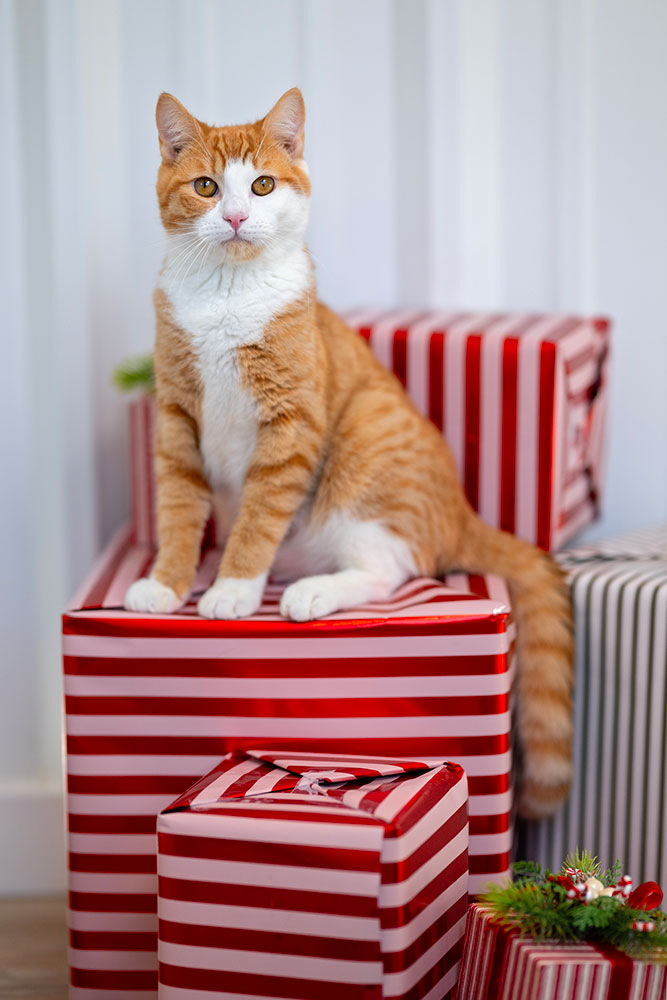
A low, sturdy gift box gives a cat a place to settle and gives you a little height to work with. Try bringing your camera down to the cat’s eye level. That straight-to-camera look feels like the cat is looking right at you and leaving space in the frame for the full tail ties it all together
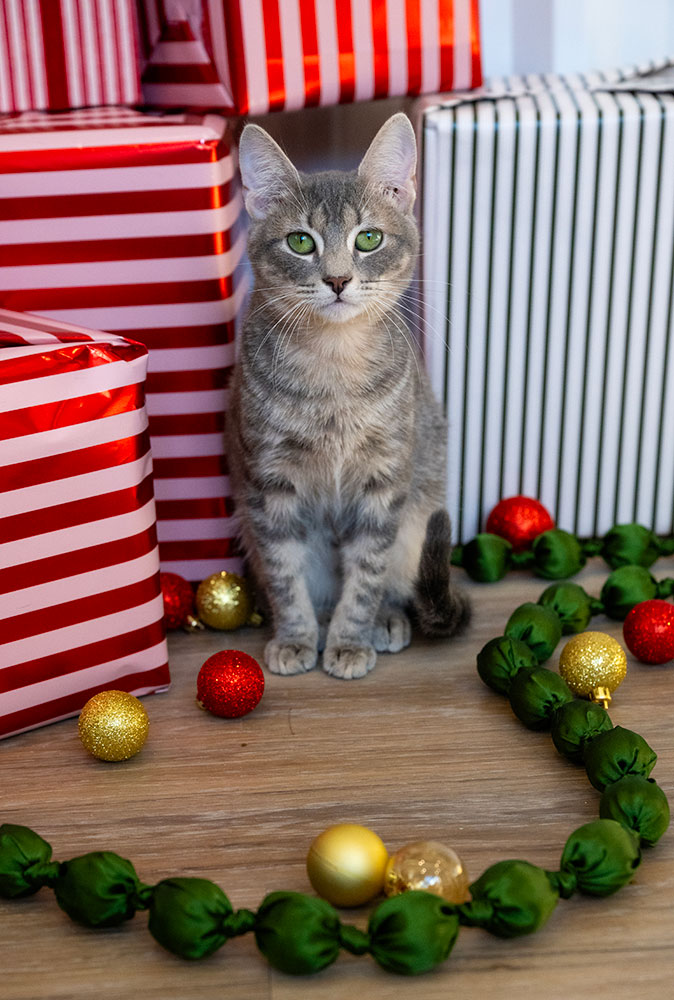
I like using wrapped boxes to frame a cat who’s happy to sit still for a moment. Adjusting the garland in front of my subject to add a soft curve to the otherwise boxier frame helps to balance out the overall image.
Get Everything ready before asking for your pet’s attention.
One of the biggest things I've learned about photographing animals is to have as much as possible ready before I even begin trying to get their attention. You may only have a few seconds of wonderful eye contact or a perfectly timed expression, and you don't want to spend it adjusting your camera.
For holiday portraits, I start by choosing or creating my scene. I might use a simple backdrop, a few carefully placed presents, or holiday decorations that add color without overwhelming the animal. In general, I like to keep the setup relatively simple since a little holiday color can go a long way, and I don't want a busy background competing with the expression I'm hoping to capture. I also make sure any decorations are safe for the animal, keeping fragile ornaments, loose ribbons, and anything they might chew or swallow well out of reach.
Once the scene is ready, I set up my lighting, choose my camera and lens, and take a test shot to check my exposure, focus, and overall lighting. A fast lens such as an f/1.4 or f/2.8 allows me to blur the background which puts more visual emphasis on the cat or dog in front of my lens. I also make sure my battery is fully charged, there’s plenty of media card space available and my camera settings are dialed in correctly. Then I'll position myself, usually starting at the animal's eye level or even a little lower, and work out my framing and composition. I'll also make any last adjustments to the background before bringing the animal into the scene. Once everything is ready, that's when the fun starts!
I'll quietly say the animal's name, make a weird sound, sing a little song, or call to them in whatever voice seems to catch their interest. Sometimes I'll hold a toy or treat near their face and quickly move it close to my lens so their eyes follow it right into the camera. In general, I tend to avoid treats though, as that can make some pets hyper focused on just getting to the treat instead of being in the moment.
Other times I'll make a completely ridiculous noise that gets me exactly the curious head tilt I'm hoping for. Every animal responds differently, so I'm constantly experimenting with what gets their attention without making them uncomfortable. The goal is to be ready when that wonderful little moment happens, rather than scrambling to get ready after it does.
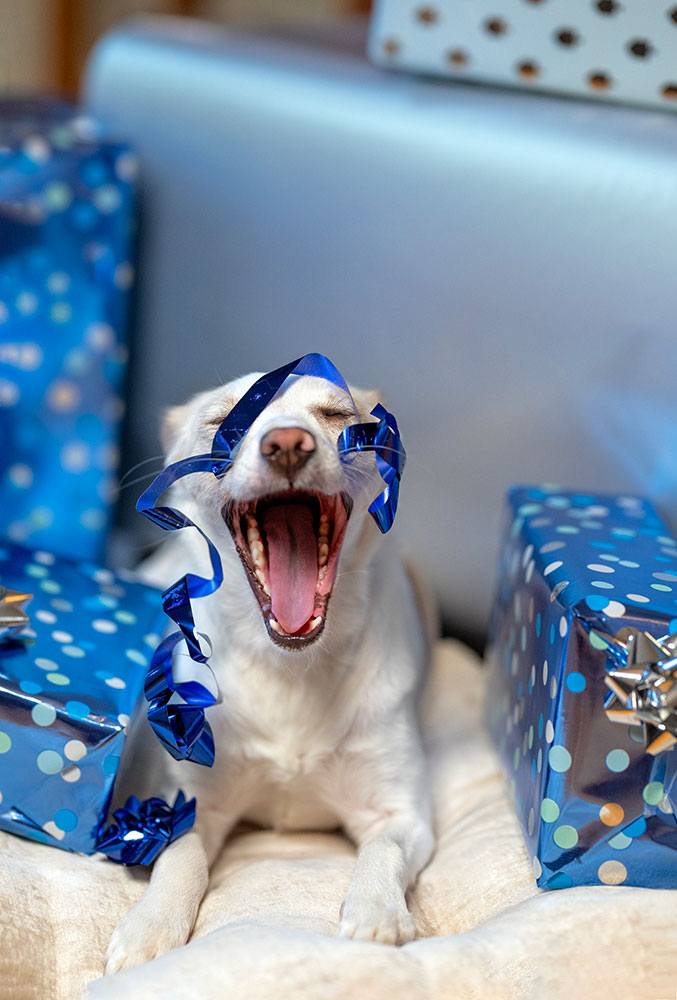
I keep shooting for a beat after I think I have the portrait, and portraits like this are often the result of that practice. A yawn can last barely long enough to notice, but a short burst gives you a few frames to choose from, and I always like the one that looks like they could be laughing. I’d pick this one for the expression alone.
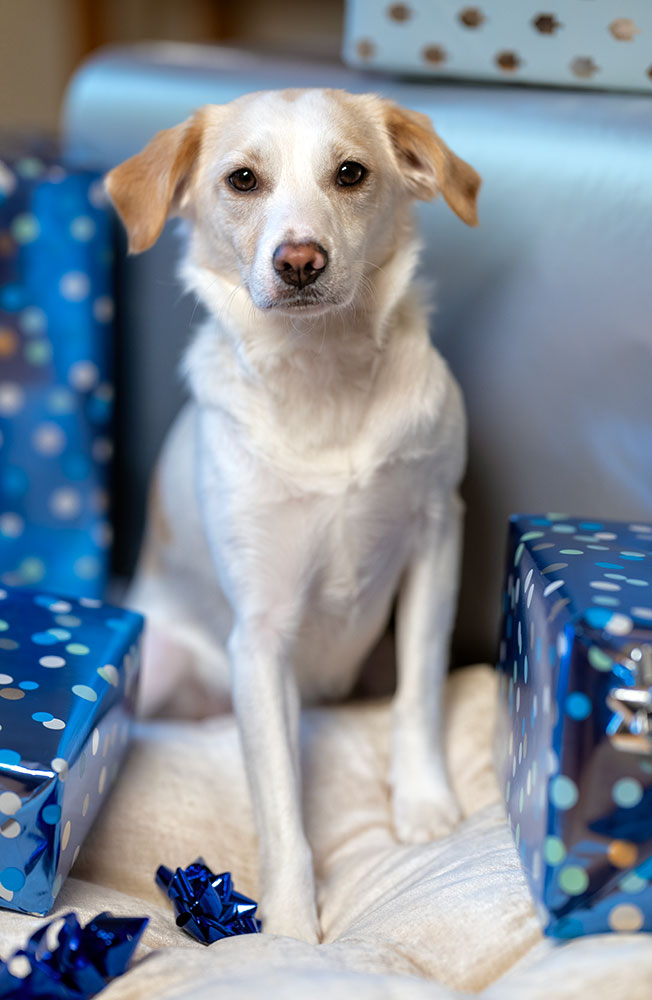
I have found that a cat or dog can position their ears 15 different ways during a single pose! One ear goes up while the other stays down, they both can be pulled back, stick straight out in helicopter mode, or fall softly to the sides, as they do here. The ears can communicate so much! The light, the framing, and even the way a pet is sitting can stay exactly the same, but that little shift in the ears gives the portrait a completely different feel every time.
Enlist some help for those split-second portraits of your pet
Whenever possible, I ask for help from someone the animal already knows and trusts. Having an extra person nearby can make an enormous difference, especially when you're photographing a pet who would much rather explore the holiday decorations than sit for a portrait.
I'll ask my helper to sit just outside the frame, where they can offer a treat, provide reassurance, or gently steady the animal for a moment if they're comfortable being touched.
We agree on a cue before we begin. I'll frame the shot, establish focus, and be ready to shoot a quick burst the instant my helper takes their hands away. There's often a wonderful split second when the animal is looking right toward the camera before deciding what to do next. Of course, not every animal needs help. Some are perfectly happy to sit in front of the camera, offering one great expression after another. But most have places to go, details to investigate, and absolutely no intention of cooperating with your holiday photo plans! For those cats and dogs, an extra set of hands can be incredibly helpful.
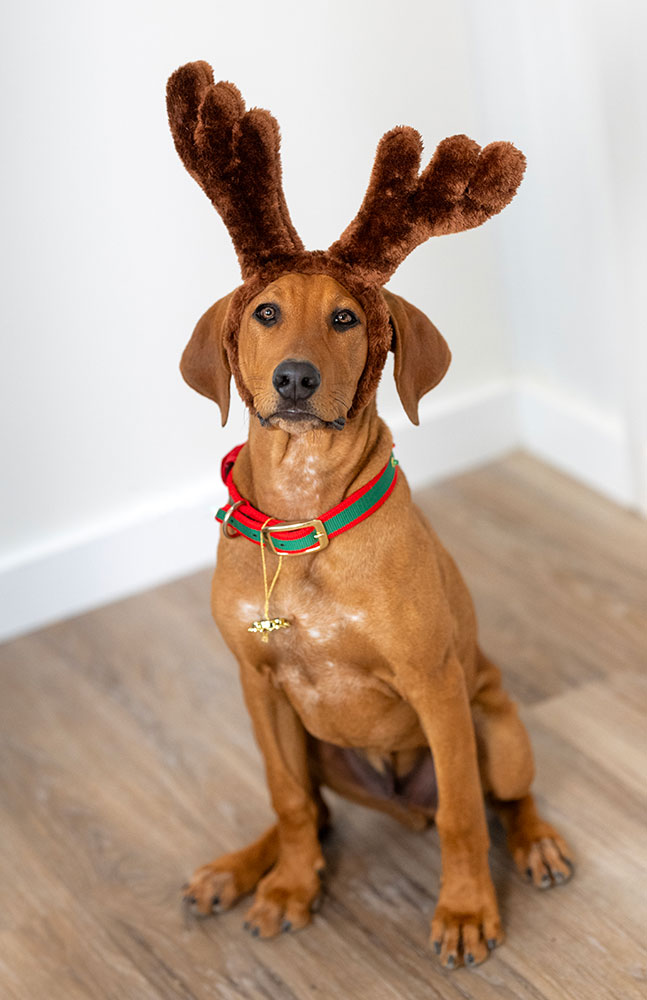
Most pets will give you at least a microsecond to play with holiday accessories. That is when shooting at a fast shutter speed can be your friend—you may only need 1/2000th of a second to get the shot you were hoping for! Make sure your framing, lighting and focus is ready before you add a playful set of antlers or hat or holiday bow, have a helper nearby, and frame some extra room around your subject since they are likely to move quickly.
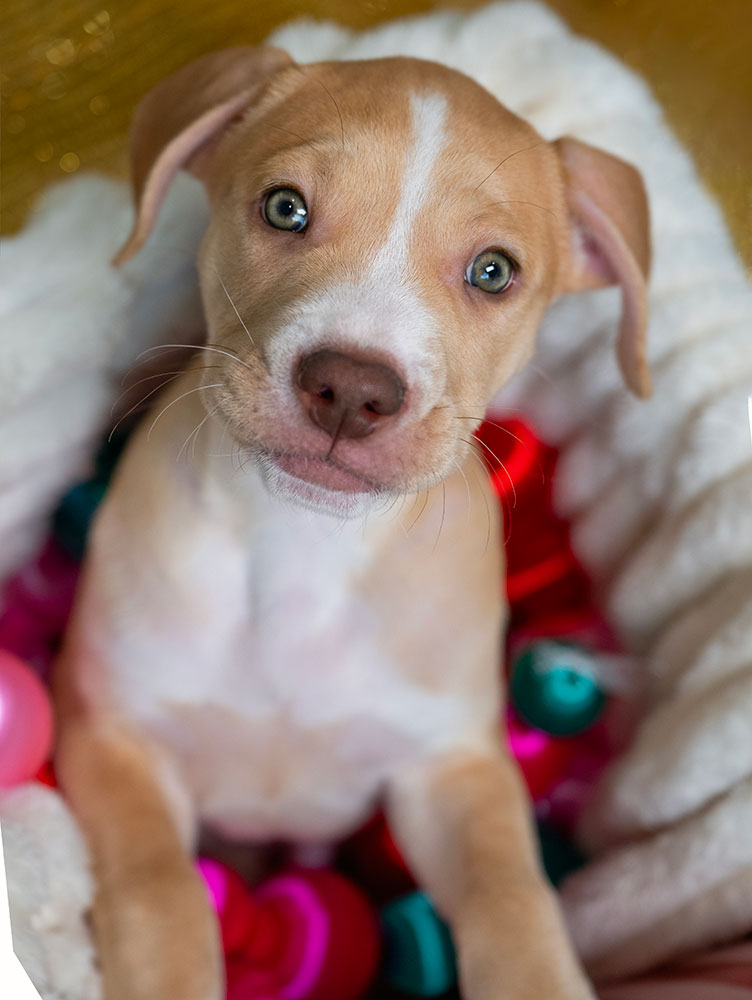
Photographing from above can work beautifully when a pet is already looking up at you. A slight tilt of the camera can give a pet portrait some of the same playful energy as a little head tilt from your subject.
Be ready for the action before it happens
Whenever I photograph animals who might move quickly (which, honestly, is just about all of them at some point), I typically set my camera to continuous AF (AF-C), often using 3D-tracking to follow the animal as it moves, and I shoot in continuous high-speed mode so I can capture quick bursts of images.
One of my favorite Nikon features is animal subject detection. Being able to keep an animal's eyes in focus as they move makes an enormous difference, especially when they're anything but predictable!
Depending on the subject, I might shoot at 5 frames per second. But when I'm photographing an especially unpredictable animal and know I may only have a split second of their attention before they're off again, I'll increase my continuous shooting speed to 10 or even 20 frames per second.
I also tend to keep my shutter speed at 1/1000 second or faster, even when an animal appears to be sitting perfectly still. In my experience, if they're not moving, it just means they're not moving yet.
And holiday portraits offer plenty of opportunities for sudden movement! A cat might reach out to investigate a decoration. A puppy might suddenly leap toward a toy. A dog might turn their head at exactly the moment someone calls their name. Some of my favorite photographs happen the instant something unexpected occurs, and I want to be able to freeze those moments sharply rather than watch them disappear in a blur. If that means raising my ISO to maintain a fast shutter speed, I'm happy to do it. I've always believed a little image noise is a worthwhile trade-off for a beautifully sharp expression that may only happen once. (Fortunately, with the excellent high-ISO performance of today's Nikon cameras, that's much less of a compromise than it used to be)!
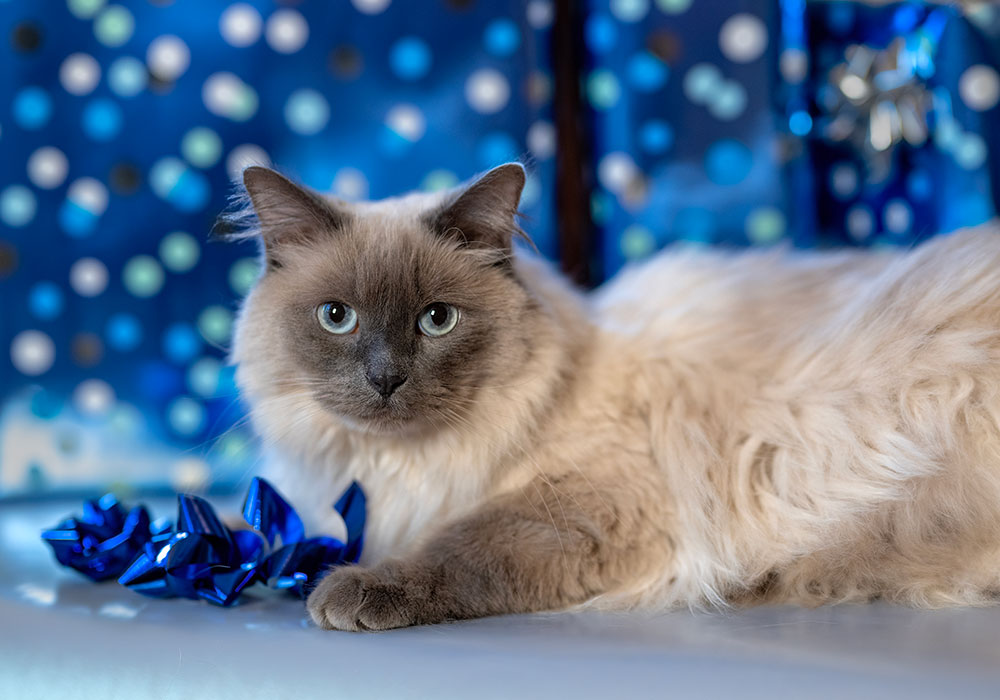
I love how the blue and silver wrapping paper picks up the color tones of this cat’s eyes. Remember to position your pet a little distance from the backdrop so the pattern behind them softens, and the eyes will stand out even more.
Leave your camera up after the shot
I've learned to leave the camera up a little longer than I think I need to when shooting portraits. Most subjects tend to relax when they think the portrait is done, including cats and dogs and other animals. That can be when you get the enormous yawn, the hilarious tail flick, or the look that suggests your cat has been very patient about all of this and would now like to discuss payment.
Holiday portraits are particularly wonderful for these moments. You might get the perfectly composed photograph of your dog sitting beside a wrapped present, but the photograph you end up loving most could be the one where they lean over to sniff it, tilt their head at an unexpected sound, or give you a look that makes their feelings about the entire photo session abundantly clear.
Give yourself a little extra room in the frame so you can follow a movement. And look for the quiet moments, too. A great holiday portrait doesn't necessarily need a perfect pose, an elaborate backdrop, or a holiday outfit. Sometimes all you need is a little festive color and an expression that feels completely true to the animal you're photographing.
Bonus tip: Consider the purpose of the photograph
At Beautiful Together Animal Sanctuary, the nonprofit organization I co-founded, I think about those details every time we photograph an animal who needs a home.
We may have three seconds, if that, before someone scrolls past their picture. For an animal who's running out of time in an overcrowded shelter, a photograph that gets someone to stop and reach out to foster or adopt can make the difference between life and death.
Sometimes what makes someone stop is a soft look from a big dog. Sometimes it's a ridiculous expression that makes them laugh and then go back to learn a little more about the animal. And sometimes it's a quiet moment of vulnerability, a look that makes you wish you could reach right into the photograph and offer them a little comfort—or, even better, a home and family of their very own. During the holidays, when so many people are sharing photographs of the animals they love, I feel particularly grateful for the opportunity to photograph rescued pets who are still waiting for someone to love them. A photograph can give someone who's never met that animal a chance to see what I got to see in person—their curiosity, their humor, their gentleness, or that wonderfully distinctive expression that makes them who they are.
So have fun with your holiday portraits. Set up the lights, arrange the decorations, and do your best to get everyone's attention at the same time. But don't worry too much when your subject has other plans. Some of the most wonderful photographs happen when we stop trying to get everything just right and start paying attention to what's actually happening in front of us.
You may end up with something even better than the holiday portrait you imagined—a photograph that captures exactly what you love most about the animal in front of your lens.


Tamara Lackey is a portrait photographer whose work has been described as "expressive, soulful, funny, beautiful" and has appeared in such publications as O Magazine, Men's Journal and Parenting Magazine. Her imagery has also been showcased on ABC's The Martha Stewart Show, ABC's Extreme Makeover: Home Edition and NBC's The Today Show. When not shooting, Tamara is writing about and teaching photography, business and work/life balance at workshops and conferences around the world.
More articles by this contributor