How Nikon Makes the ZR Its First Groundbreaking Cinema Camera
Documentary filmmaking with the ZR: A behind-the-scenes look at the process, and the result of the camera’s quality and capability.
Just about everything you initially need to know about the versatility, capability and quality of the ZR cinema camera comes right at you in the visuals of the documentary short film and behind-the-scenes that accompanies this story—and in something director Justin Porter says about the camera,“[The ZR] is for anyone at any level of filmmaking.”
And in the words of the film’s cinematographer Mitch Blummer, “It can roll with the punches, react to new ideas very quickly, even under the pressure of time and budget.” He adds, “That’s what I like responding to as a filmmaker—those moments of inspiration when you pivot, you improvise, you play jazz. And this camera has the resources you need to do that.”
• REDCODE RAW (R3D NE)—With the ZR, you can capture RAW footage in R3D NE, which leverages RED Color Science and can be used alongside RED footage with powerful RAW controls.
• 32-bit Float Audio—Capture higher quality in-camera audio and experience the ability to edit audio more flexibly by enabling the recovery of soundbites in difficult audio conditions.
• A Four-inch DCI-P3 Monitor—The large built-in monitor of the ZR features a DCI-P3 display, which visualizes professional cinema-quality colors right in the camera’s native display.
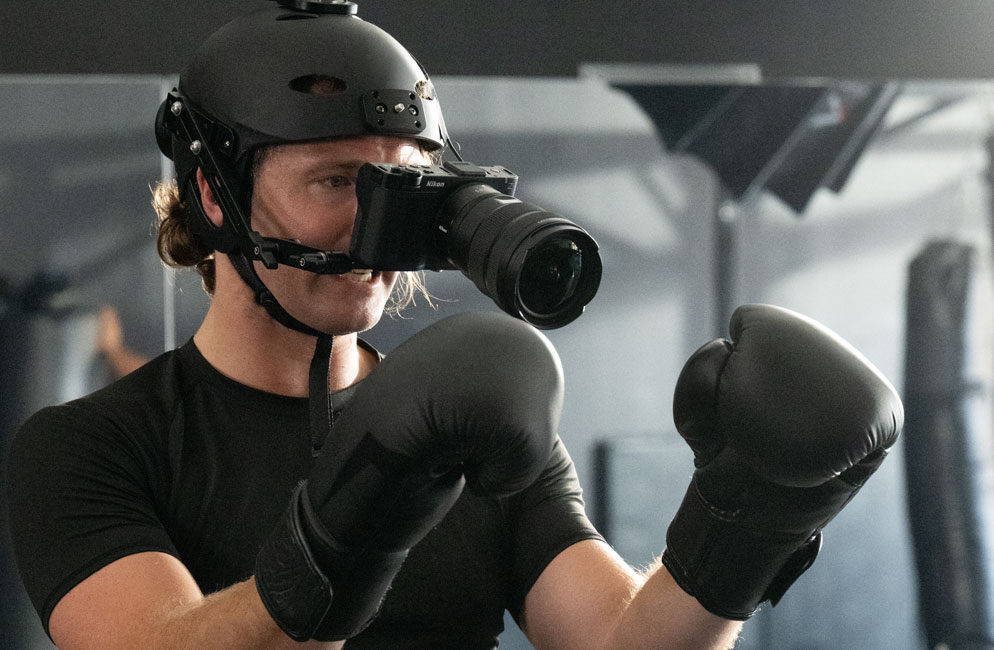
Speaking about how the features of the ZR enabled creative freedom in making the short film, Mitch says, “We were telling a story about an athlete, a boxer, and that’s a sport that specifically lends itself to a particular perspective. [Strapping the ZR to a helmet] was a perfect way to use such a small and light-weight camera.”
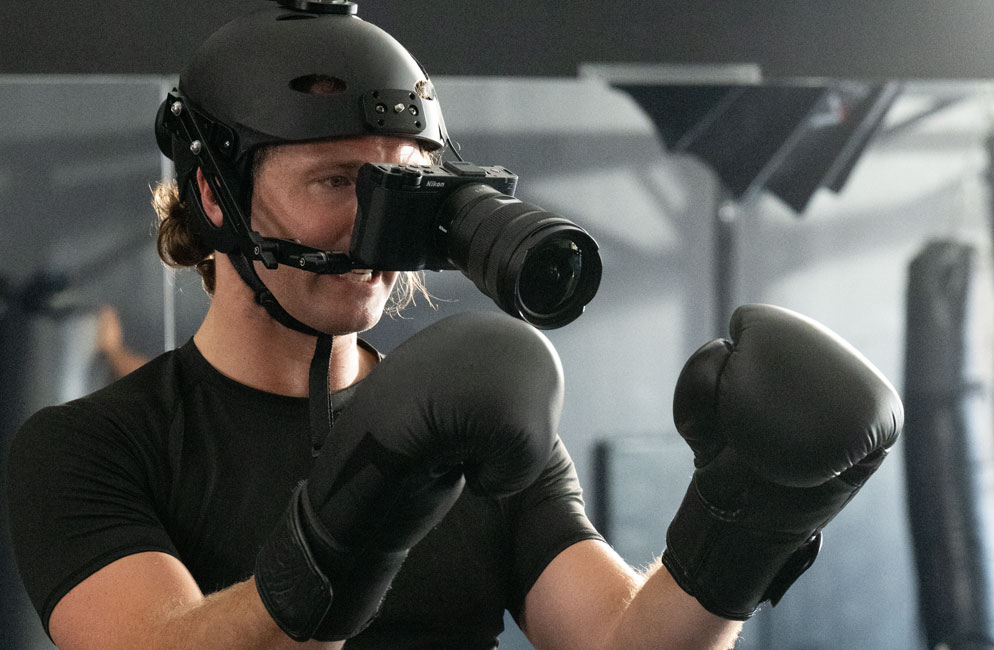
BTS photo of Mitch with the ZR strapped to his helmet
[Strapping the ZR to a helmet] was a perfect way to use such a small and light-weight camera.
The physical build of the ZR allows filmmakers to capture footage with RED Color Science in unique angles, rigs and configurations, such as helmet cam setups, that were previously not possible with larger, traditional cinema cameras—and all without sacrificing the image quality.
“Then, for all the natural, documentary-style audio, we recorded with the camera’s internal mic,” Mitch says. “For interviews we used a [Tascam XLR] adapter that allowed for a higher-quality XLR mic to be plugged into the camera. We didn’t need an external sound recorder, boom operator or sound recordist on set. That enabled us to move more freely and shoot more angles simultaneously without worrying about getting the recordist in the shot.”
Whether filmmakers are looking to record through XLR with external microphones, switching to the camera’s digital hot shoe with the new Nikon ME-D10 shotgun microphone, or leveraging the built-in array of microphones in the ZR, all methods can record in 32-bit float.
When looking at the ZR as a complete package, a compact all-in-one solution across imaging, audio and display, the camera’s technical specs do more than just lead in their class, they add more broadly to freedom in the art of filmmaking.
As Mitch says, “[With the ZR] we can make quick changes from what we originally thought of to better tell the story.” See it for yourself in the documentary short film.
There’s a lot more about the ZR and its capabilities at Nikon’s ZR webpage.