Get Low: Why Your LCD Is Your Secret Weapon
Bend, Tilt or Shoot. How to Capture Wildlife from Ground Level
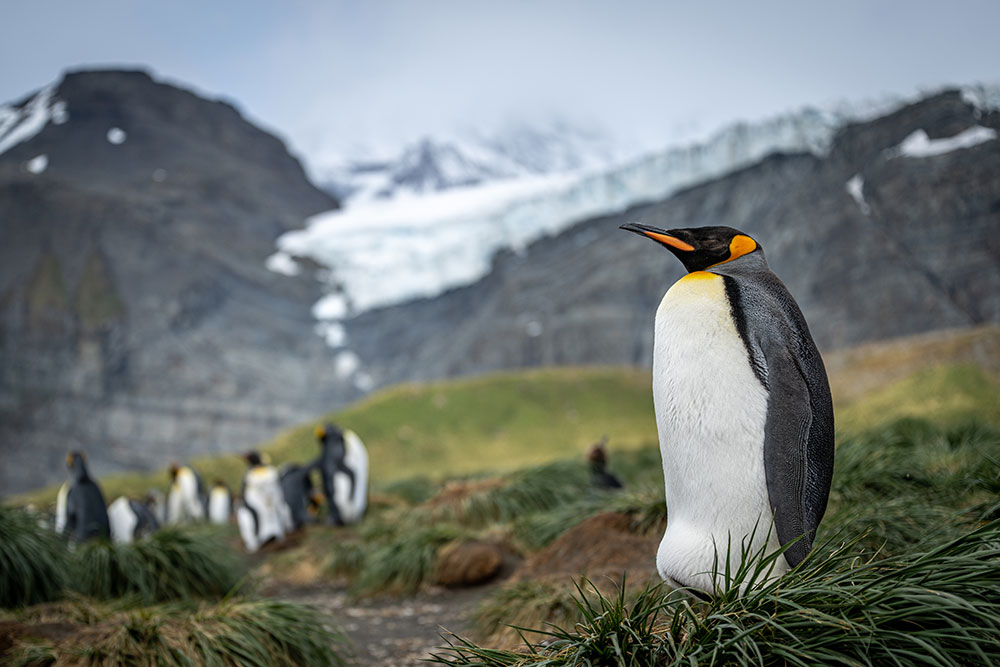
Z9, NIKKOR Z 24-70mm f/2.8 S II, 1/1600 sec, f/2.8, ISO 64. A king penguin rests on a grass clump near a large king penguin rookery at Gold Harbor, South Georgia Island.
On a recent trip to Antarctica my wife and I were leading a three-week photo workshop, and one of the main attractions was penguins. My Nikon cameras proved to be ideal for the low-angle shooting that was necessary during the trip.
We learned about the restrictions on the beach from our expedition leader, Hannah. “When we land on shore there are strict rules for visitors. Most importantly you’re not allowed to sit on the ground or put your pack down. You can’t even squat. The only thing that can touch the ground is your feet. For the photographers in the group, I recommend the ‘tripod’ technique. Just bend at the waist and hold your camera near the ground.” Easier said than done.
On the trip we were able to see and photograph a variety of penguin species including Gentoo, King, Rockhopper, Macaroni and Chinstrap penguins. Our first landing was at a gentoo penguin rookery. Their curious nature makes them a photographer favorite.
South Georgia Island is home to the largest king penguin rookeries on the planet. I have been dreaming about photographing nearly 150,000 king penguins at Salisbury Plain for decades. This is a bucket list trip for me. And I hope to capture eye level images of penguins. Bird flu struck Antarctica in recent years, and there has been much concern about harming the penguin colonies by cross contamination. Each year expedition ships visit these remote areas, and to prevent any spread of disease we follow strict protocols. Before and after each landing we sanitize our boots and do regular ‘bio-hazard’ parties on the ship to make sure we don’t have any seeds, grasses or penguin scat on our gear.
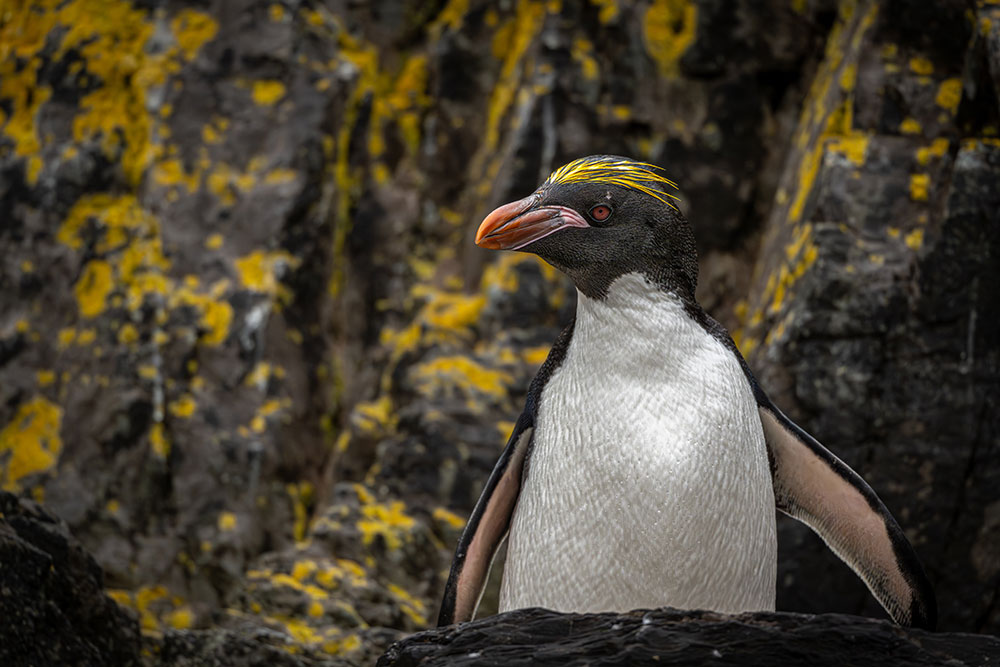
Z9, NIKKOR Z 600mm f/6.3 VR S, 1/4000 sec, f/6.3, ISO1800. Macaroni penguin nesting on the cliffs at Hercules Bay, South Georgia Island.
How to shoot at a low-angle
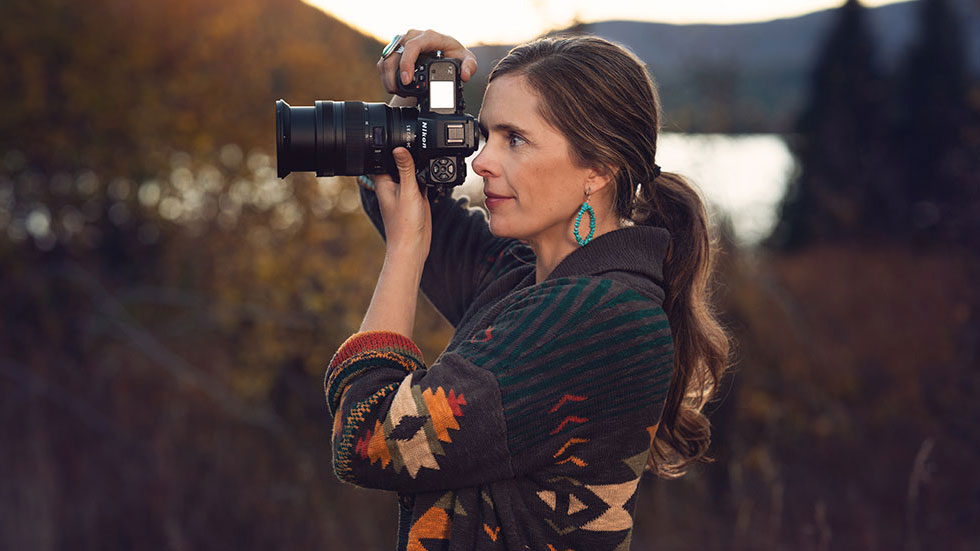
We knew before arriving how we’d have to shoot and had already prepped our group on low perspective photography techniques. Thanks to the tilting LCD screen on my Nikon Z9, I can focus while bending over quite easily.
There are specific settings and hand positions that give you much better results using your LCD to focus near the ground. I was using a Z9, Z8 and a Z6III along with the new NIKKOR Z 24-70mm f/2.8 S II and NIKKOR Z 100-400mm f/4.5-5.6 VR S lenses for most of my ground level photography in Antarctica.
When you’re shooting bent over (or crouching down) trying to support a camera, lighter lenses work better. As much as I wanted to bring my NIKKOR Z 600mm f/4 TC VR S lens, I left it at home. Thankfully the penguins are close, but we had to keep a minimum distance of five meters between us and the birds.
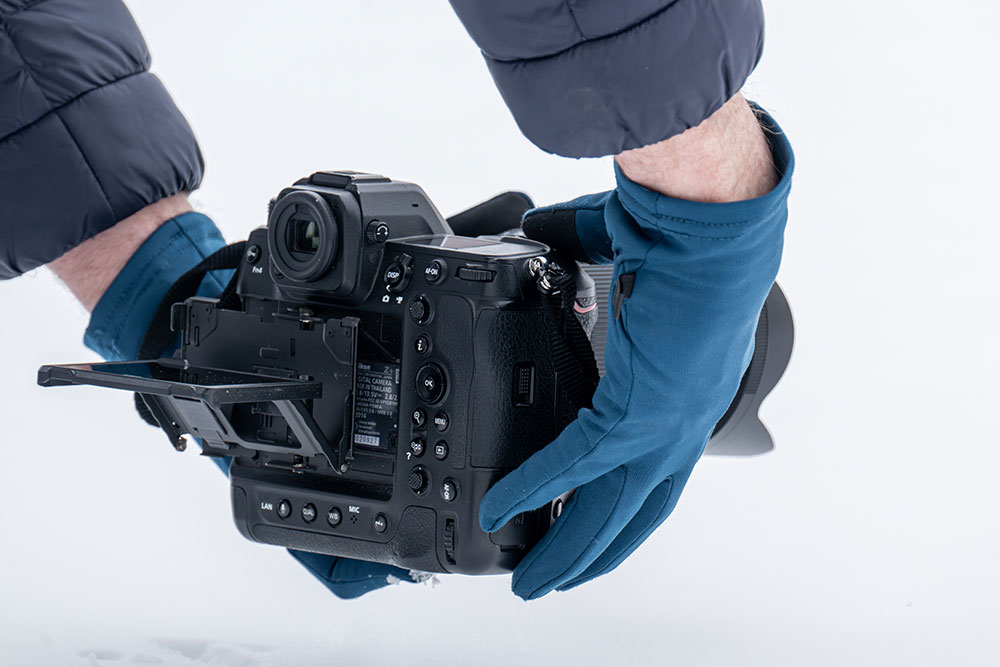
Ground level shooting using the LCD with the left hand holding the camera steady and the right hand positioned to help steady the camera while allowing the thumb to press the shutter.
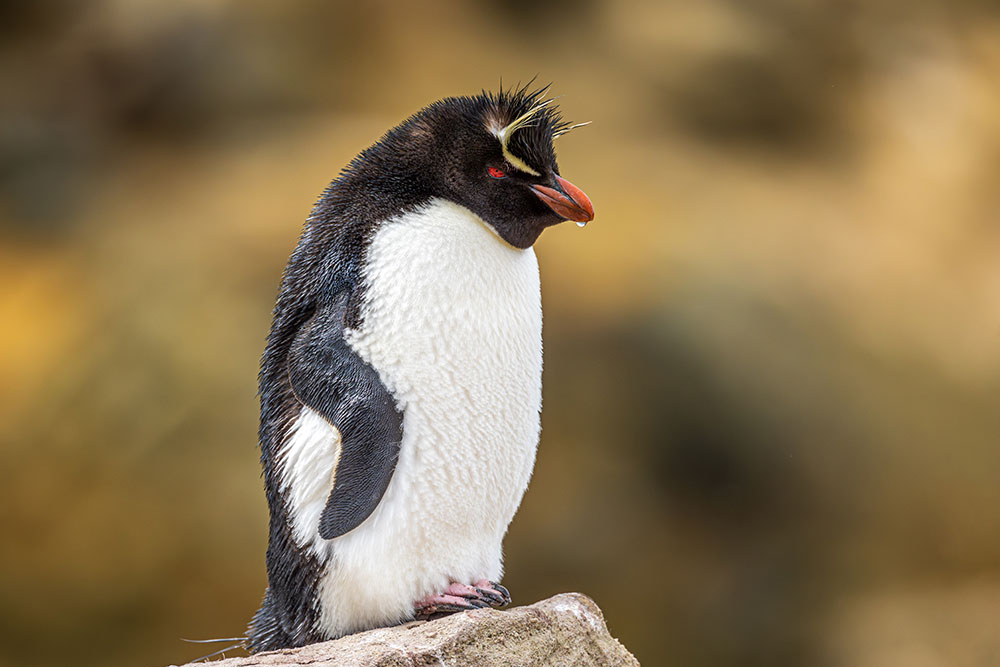
Z9, NIKKOR Z 600mm f/6.3 VR S, 1/3200 sec, f/6.3, ISO 720. A rock hopper penguin perches on a rock in large rock hopper rookery above the ocean. New Island, Falkland Islands.
Composing images using a tilting or Vari-angle LCD
Why the need to focus so low to the ground? Because being on eye level connects the viewer with your subject. You see the world the way a penguin sees the world. And getting close to the ground gives you beautiful soft-focus foregrounds leading to your subject. I even brought my NIKKOR Z 135mm f/1.8 S Plena to Antarctica for ground level shooting. The silky-smooth foregrounds are sublime.
When you’re trying to photograph wildlife at low perspectives, be aware of your terrain and subjects. I found many locations in Antarctica where the penguins were on a small outcrop above me. I was shooting eye to eye with the birds while standing up. The same thing happens photographing many types of wildlife.
But at other locations I needed to use my camera's LCD monitor to focus and compose while holding my camera inches from the ground. Try these tips for ground level monitor focusing, and with a little practice, you’ll master the technique.If you’re using a lens that has a tripod collar, rotate it so the foot is on top of the lens. Lenses like the 100-400mm and 600mm have a foot that acts like a handle when it is positioned on top of the lens. Smaller lenses like the 24-70mm don’t have a collar but are lighter and easier to hold.
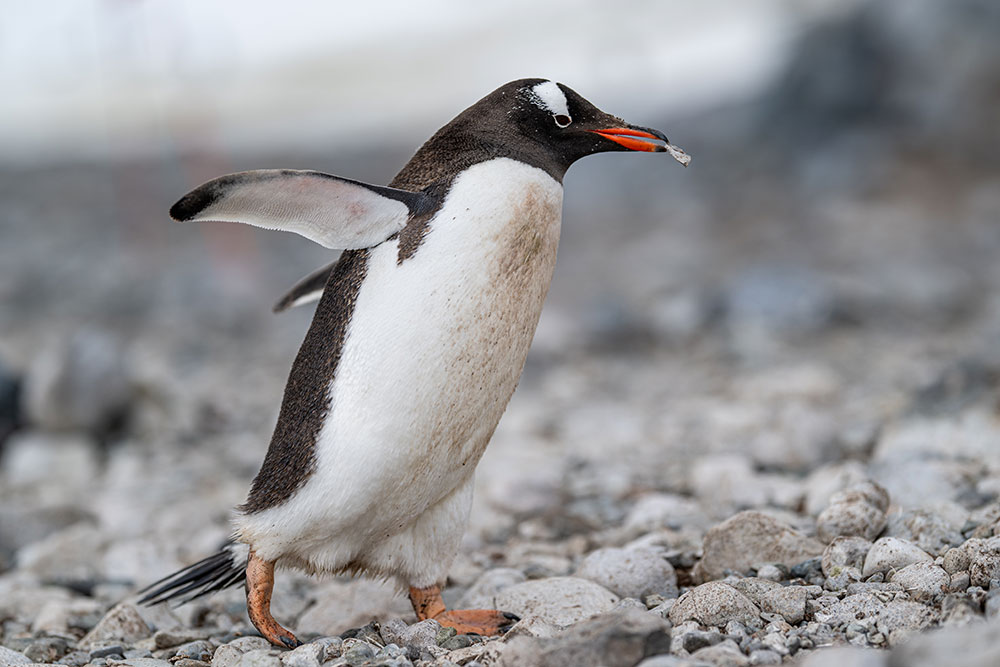
Z9, NIKKOR Z 135mm f/1.8 S Plena, 1/4000 sec, f/1.8, ISO 64. A gentoo penguin carrying a rock to its nest. Gentoo penguins use small rocks to build their nests. Cuverville Island, Antarctica.
Focus settings and Subject Detection
Next, choose your autofocus area and subject detection option. For penguins and other birds, I used Auto-area AF with bird subject detection selected. Auto-area AF worked great for most situations. If I saw a penguin on my LCD I knew my Z9 had focused on it. If I had multiple penguins in the frame, I chose 3D AF mode. Using 3D autofocus made it easier to select a specific bird in the frame for focus. Use AF-C mode to track moving subjects.
Set your focus so that it will be triggered by your shutter button. (I normally use back button focus, but it is awkward bending your wrist and pressing the back button to focus when you’re holding your camera at ground level.) It’s much easier to touch one button to focus and shoot at ground level while using the LCD. I hold my camera such that my thumb is pressing the shutter while my fingers are supporting the bottom of my camera. You can also set the camera to allow you to snap an image using the touch LCD.
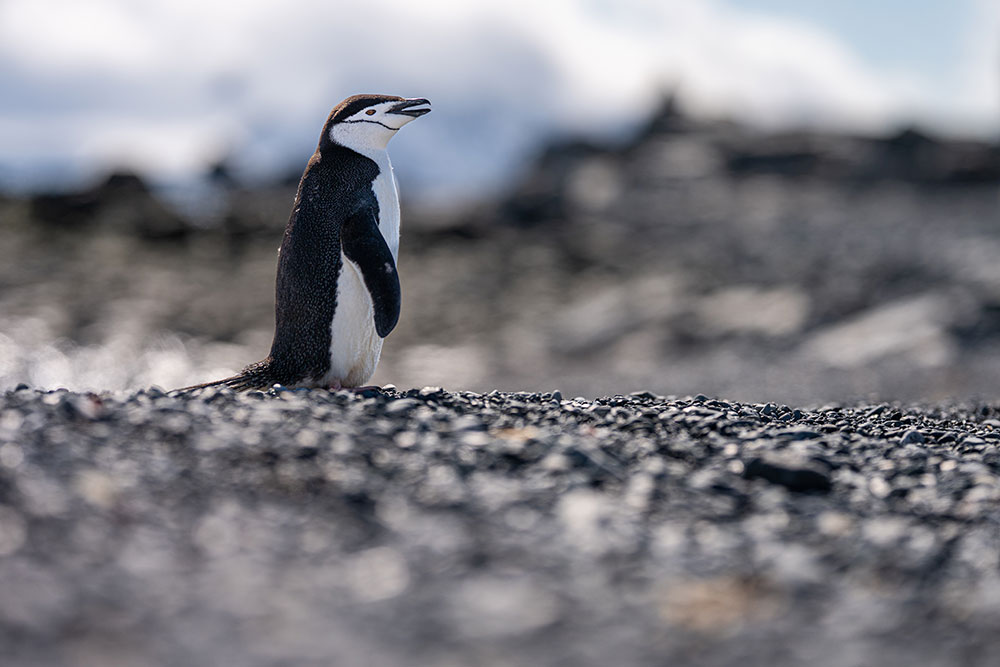
Z6III, NIKKOR Z 135mm f/1.8 S Plena, 1/16000 sec, f/1.8, ISO160. A chinstrap penguin returning from the ocean to its nest. Halfmoon Island, Antarctica.
Experimenting with the foreground in your compositions
Adjust your LCD screen for the best viewing angle. This is often overlooked and can make visibility much better on the screen. I found tilting the screen a few centimeters could greatly reduce glare and produce much better visibility. This was especially helpful when shooting on bright snow.
Consider removing your camera strap while shooting in this situation. Having a camera strap around your neck makes it difficult to shoot at ground level bending from the waist. I only used one camera while shooting at ground level. A second camera around your neck will get in the way when you bend over.
Experiment with how low to go. Foregrounds transform from one foot down to ground level. The lower you go the foreground gets more blurred and minimized. Watch your background. Occasionally I found the horizon line crossing right through the neck of a penguin, which didn’t look good.
Try photographing below ground level. I really liked putting my camera below the snow line or beach rocks while photographing a penguin. This angle produced a beautiful soft border on the bottom of the frame and added mood to the image. Whether you’re going to Antarctica, or to your local park, photographing from ground level produces compelling images. Tilt your LCD screen out, get low, lean over or crouch down, and connect your audience with a bird’s eye view.