Understanding and Using CFexpress (Type B) Media Cards
CFexpress Type B is a high-speed, high-capacity media format that replaces the XQD format in modern high-performance Nikon DSLRs and mirrorless cameras. Despite the name, CFexpress Type B is a completely different standard (and physical shape) to the much older CompactFlash cards used in some previous-generation Nikon DSLRs.
How to read a CFexpress Type B card—terminology explained
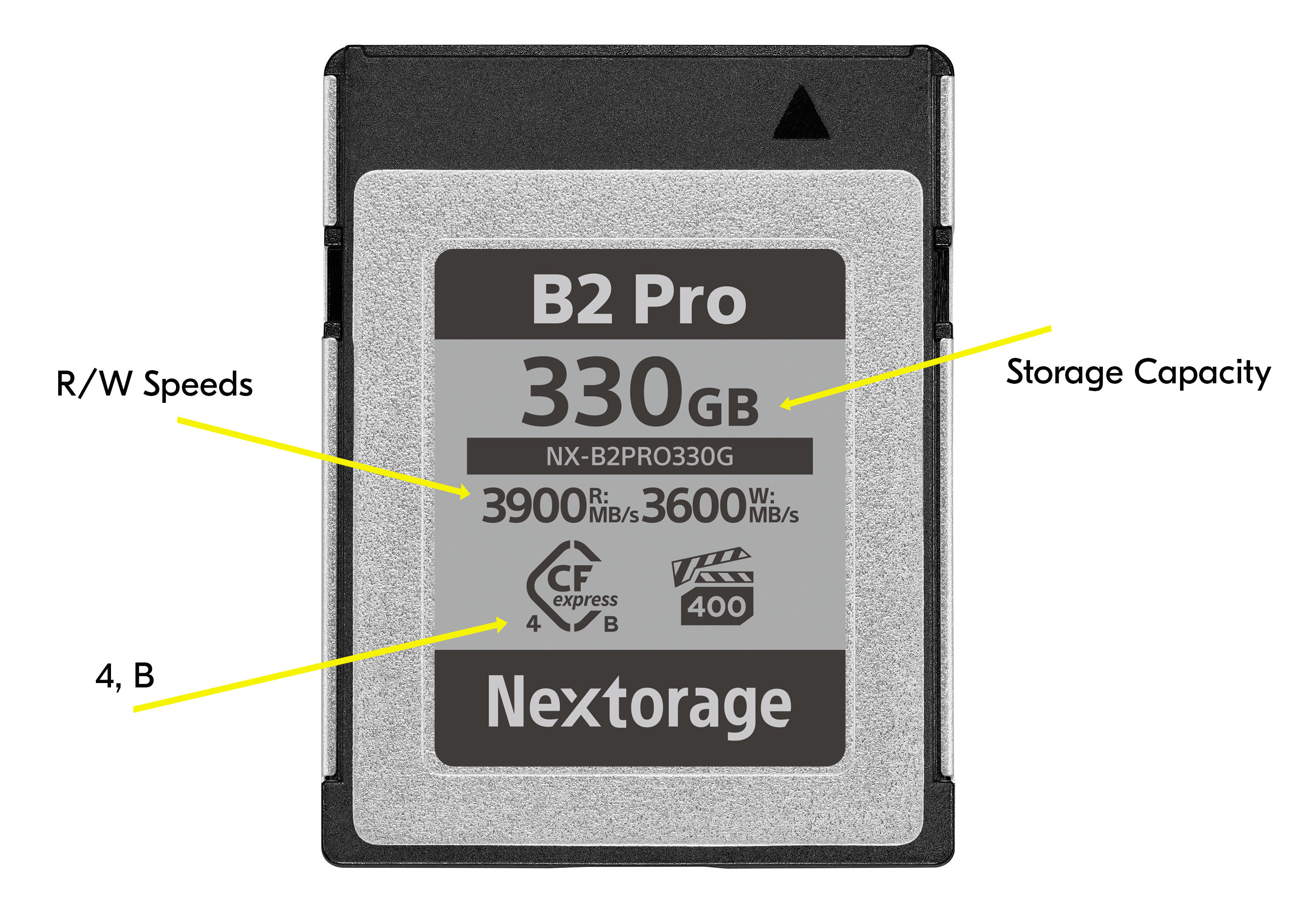
“B” This tells you that the card is a CFexpress Type B card, as opposed to the smaller Type A card format or the less common Type C format, which is used in computers and portable storage devices.
“R/W” A common abbreviation for “Read” and “Write”, which refers to the maximum speed at which data can be read from, and recorded to, the card respectively—usually given in megabytes per second (MB/s).
“Sus. W / Sustained W” Not always labeled, this refers to the maximum sustained speed at which data can be recorded to the card. This is a more useful figure in real-world use, especially if you’re shooting high-resolution video or extended high-speed bursts of still photos.
“4” This indicates that a card meets the high-speed, high-capacity CFexpress Type B 4.0 standard.
“[XXXGB]” This refers to the maximum capacity of the card, in gigabytes (GB) or Terabytes (TB). A higher capacity card will have more room to store photos and video files.
Advantages of CFexpress Type B compared to XQD
The newer format has some important advantages over XQD, including:
Faster maximum data read/write speeds—especially cards that take full advantage of the new 4.0 standard.
Greater maximum storage capacity.
Better commercial availability, and more choice of manufacturers.
A wider ecosystem of accessories, including card readers.
Substantially lower cost per megabyte of storage.
Note: Almost all Nikon cameras that can accept XQD cards can also accept CFexpress Type B cards in the same slot, and vis-versa,1 but XQD card readers cannot read CFexpress Type B cards. So, if you plan to add CFexpress Type B media to your XQD collection, you will also need to purchase a dedicated card reader.
Advantages of CFexpress Type B compared to SD
Some Nikon cameras that support CFexpress Type B media also include a secondary slot for lower cost, widely available Secure Digital (SD) or MicroSD cards. So why invest in costlier CFexpress Type B media?
Higher speed
CFexpress Type B cards are capable of much higher speed than SD cards, allowing data to be written and read at maximum theoretical rates of 3,000+ MB/s2, compared to around 300 MB/s from even the fastest SD cards. This means that if you’ll be able to take full advantage of the high-speed shooting and high-resolution video capabilities of current and future-generation Nikon camera without the risk of slowdowns due to “data bottlenecking”.
CFexpress Type B maximum data read speeds are typically even higher, which makes transferring and archiving data blazingly fast via a compatible high-speed USB or Thunderbolt card reader.
Larger maximum capacity
CFexpress Type B cards (4.0 standard) are available in capacities up to 4TB, compared to a maximum of 2TB for SD cards. While most photographers and filmmakers won’t need that much in-camera storage on a regular basis, there are situations where the extra capacity might be essential—for example when shooting 4K or 8K RAW video, when your Nikon camera is set up remotely for automatic capture, or for extended timelapse shooting.As the speed and resolution of digital cameras increases, you’ll find that by adopting CFexpress Type B media now, you’ll be able to enjoy the full performance of your Nikon gear for years to come.
What CFexpress can mean for you:
CFexpress cards are able to keep up with the shooting speed of the latest cameras, clearing the buffer faster. This means that for sports, photojournalism and wildlife photography, you will capture more decisive moments in multiple bursts of continuous shooting; and for filmmakers, you can shoot higher resolution like 4K, 6K, 8K and record longer, in-camera than smaller, slower media.
Storage capacities that can hold large amounts of RAW NEF files and/or high-resolution video files mean you won't have to stop shooting to change cards and risk missing the action.
Faster transfer rates from card to computer mean you can get back to shooting quicker.
CFexpress cards are more durable than other media card formats.
What the pros are saying:
“As a creator, storage is one of the most important factors to consider, and with CFexpress Type B, I feel more confident than ever in protecting my work. CFexpress Type B cards do everything XQD cards can but better. These high-speed cards allow me to expand into shooting 8K video, endless timelapses and more.” —Mike Mezuel II, action and portrait photographer.
In the world of sports, everything moves incredibly fast, and it is imperative that I must be able to do the same. Not only are CFexpress Type B cards capable of delivering the fastest speeds and the largest capacities, but they are also the most physically robust cards I have ever owned. The fact that I can use CFexpress Type B media interchangeably in both my Nikon Z mirrorless cameras and my RED cinema gear is another bonus, simplifying my gear and my workflow. —Andrew Hancock, Sports photographer.