You Can Use Vintage Nikon Lenses with Your Z Series Mirrorless Cameras
Did you know you can use most of your older, vintage f-mount interchangeable lenses with your new Nikon Z series mirrorless camera? You can, with the Mount Adapter FTZ II (and the now discontinued original Mount Adapter FTZ. This easy-to-use adapter gives you the ability to use over 360 NIKKOR f-mount lenses—the lenses that you used with your Nikon film and DSLR cameras, including over 90 NIKKOR FX or DX AF-S Type G/D/E, AF-P type G/E, AF-I type D lenses, and AF-S/AF-I Teleconverters that retain full AF/AE compatibility.* Meanwhile, many NIKKOR lenses dating as far back as the 1950s can also be mounted to Z system cameras via the FTZ and FTZ II adapter with some limitations. Check FTZ compatibility here.
From fisheyes to perspective control lenses, fast primes to super telephotos, the Mount Adapter FTZ II (and the earlier Mount Adapter FTZ) brings so many possibilities to Nikon mirrorless cameras.
Many older non-CPU lenses (lenses without a central processing unit, which lack an electronic interface) can be mounted on a Z series mirrorless camera via the FTZ and FTZ II and can even benefit from in-camera VR. For optimal VR performance, you must register the focal length of the lens in the camera. To do this, go to the setup menu, select “Non-CPU Lens Data” and enter the lens’ focal length and maximum aperture.
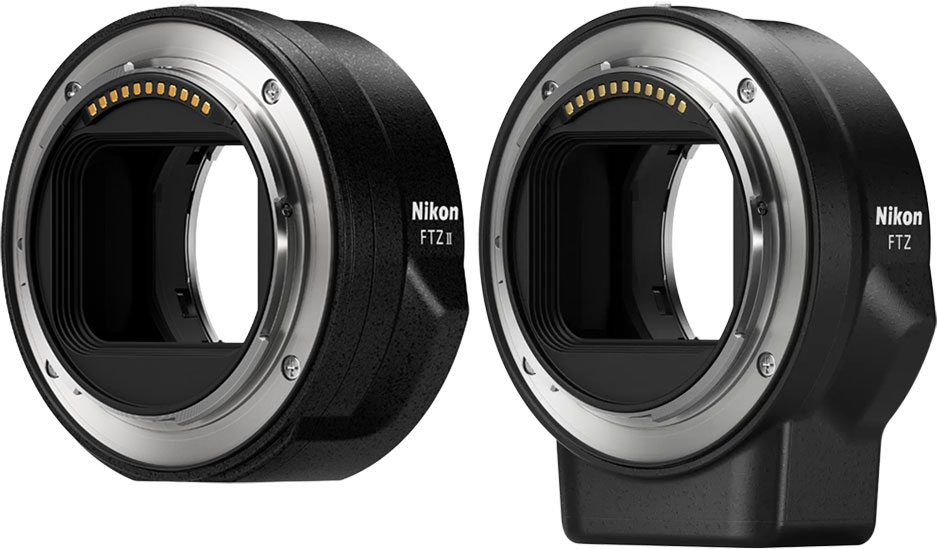
(l. to r.) Mount Adapter FTZ II and the original Mount Adapter FTZ. The more ergonomically designed FTZ II doesn't incorporate a tripod foot for easier use with Nikon Z series camera bodies that can utilize an optional power battery grip.
How the Mount Adapter FTZ/FTZ II works
There is no glass inside of the Mount Adapter FTZ II, which means nothing gets between your lens and your image sensor. No loss of brightness, contrast or speed! It simply gives the smaller mount of the F-mount (DSLR) lenses a way to attach to the larger Z mount of Nikon mirrorless cameras and place the lens at the appropriate distance from the sensor. You retain all of the image quality, resolution, clarity and sharpness as well as autofocus performance*, weather sealing and comfortable handling.
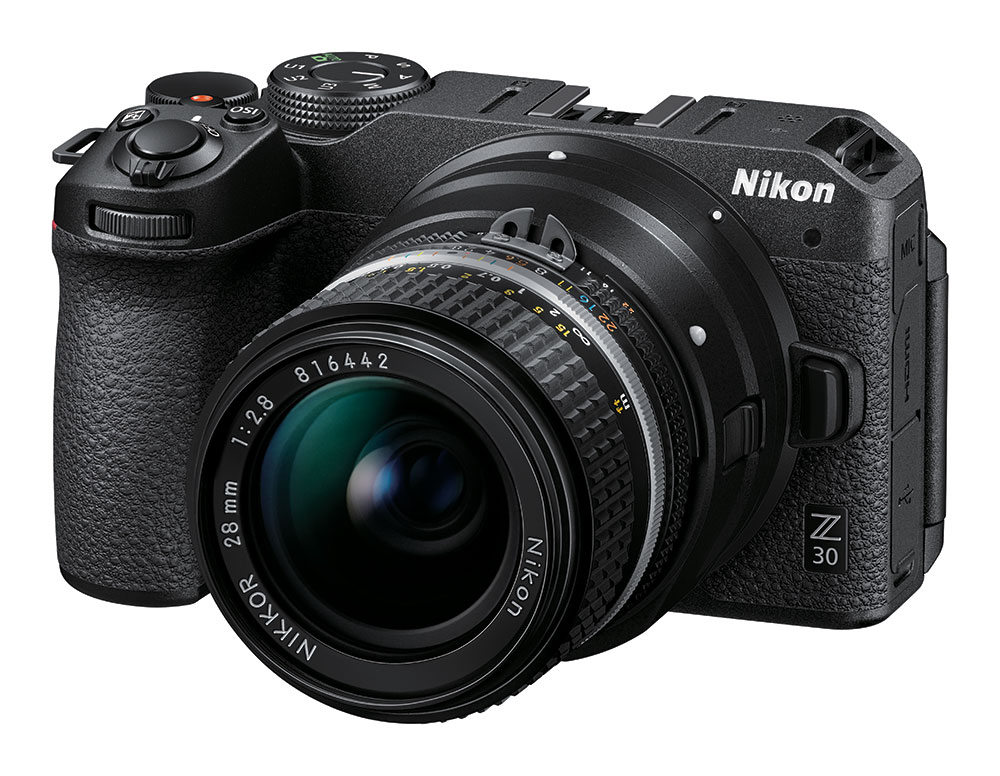
The APS-C size/DX format Z 30 like all other Z series mirrorless cameras can accept the FTZ II, allowing you to use f mount NIKKOR lenses.
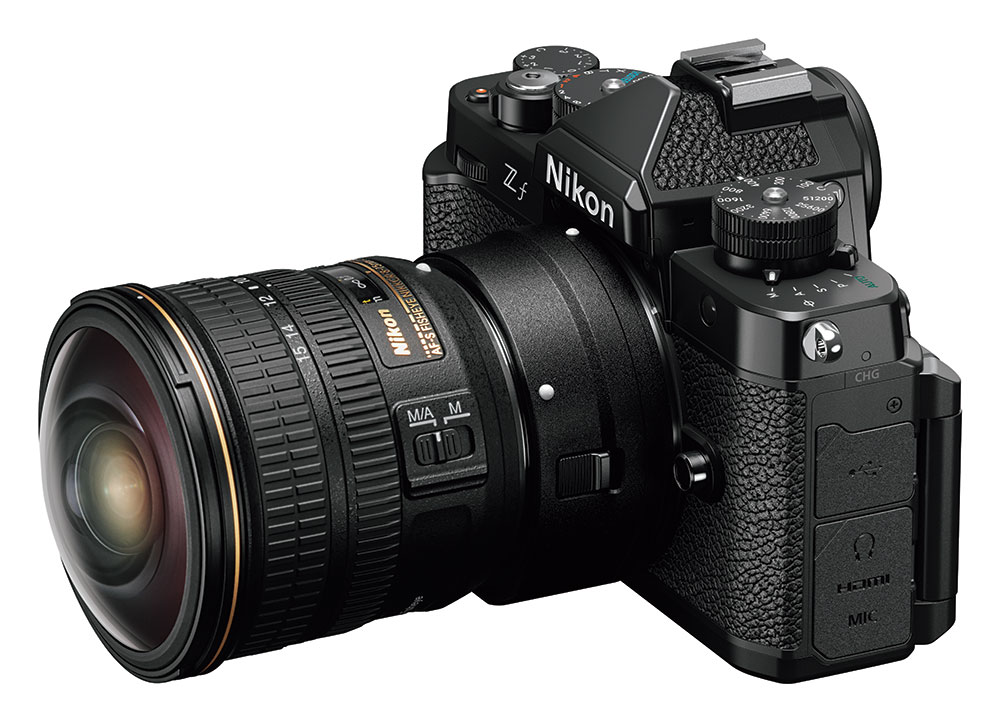
The full-frame/FX format Z f (which features its own retro design), like all other Nikon Z series mirrorless cameras can utilize the FTZ II, allowing the use of f mount NIKKOR lenses. The lens attached to the Z f is the AF-S NIKKOR Fisheye 8-15mm f/3.5-4.5E ED.
Streamlined design of the FTZ II
What’s the difference between the FTZ and the FTZ II? The Nikon Mount Adapter FTZ II adapter is an updated version of the original FTZ (now discontinued). Functionally, the two adapters are identical. The original model had a tripod foot mount which was removed on the FTZ II to make it easier to use with Nikon mirrorless cameras when the vertical battery grip is attached. The streamlined design of the Mount Adapter FTZ II means comfortable shooting in any direction, including vertically and it accommodates wider tripod plates on your camera and battery grips.
Built from magnesium alloy, the Mount Adapter FTZ II (and older Mount Adapter FTZ) is strong and lightweight with a durable finish. It's extensively weather-sealed to preserve the performance of pro-level cameras and lenses. And it makes a precise fit with the camera and lens, crucial for meticulous performance.
An added benefit of adapting your older F-mount lenses is that they can benefit from the Vibration Reduction image stabilization system built into many Nikon Z series mirrorless camera bodies. Compatible F-mount NIKKOR lenses effectively gain image stabilization in 3-axes (Pitch/Yaw and Roll). When an F-mount NIKKOR lens with VR is attached to a VR-equipped Z-system camera, the optical VR in the lens works as normal, with stabilization in the roll axis handled by the camera.
Four Nikon Ambassadors’ favorite f mount lenses
We asked a few of our Nikon Ambassadors why it is important that they can still utilize their favorite f mount lenses with the Nikon Z series cameras they own. These image makers utilize many of the NIKKOR Z lenses but they also have treasured F-mount glass that they’re glad they can still use. Read on for their thoughts.
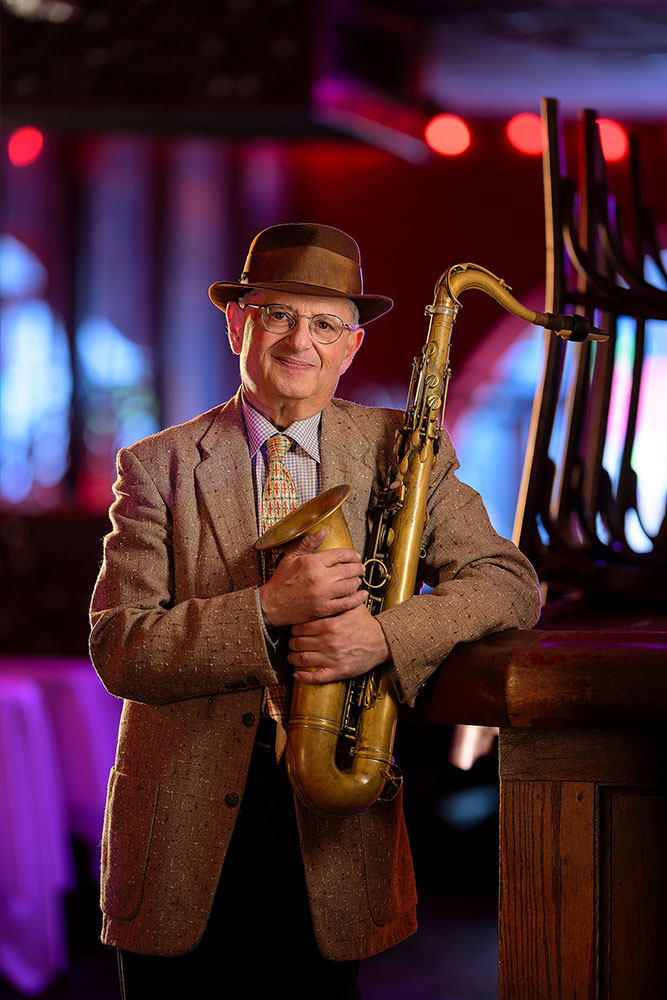
Joe McNally used the AF-S NIKKOR 200mm f/2G ED VR II lens—one of his favorite for portraiture—on a Z 8 mirrorless camera to create this portrait of a musician. 1/10 second, f/2, ISO 80, manual exposure, Matrix metering.
JOE McNALLY, Nikon Ambassador and pro photographer explains why the Mount Adapter FTZ is an essential part of his kit. “I grew up on F mount lenses, and while I’m thrilled by the new S series glass, I still have a reverence for the lenses of yore. In no particular order, I’ve got a 500mm and a 1000mm mirror (catadioptric), and in fact just used the 1000mm lens to shoot some scenery on my block. I also have the legendary 8mm f/2.8, which has amazing edge to edge sharpness. But the crown jewel of my older glass is the f mount 200mm f/2. It is a lens I use regularly for portrait work, and I will never dispose of it. The sharpness is acute, and the focus drop at f/2 gives the background a beautiful shimmer. (See image above). It is rugged, in the true tradition of Nikon glass, and has stood the test of time. It is just as much a go to lens for me now, having owned it for easily 25 years, as it was when I bought it. I have shot dance for many years, and it is the perfect theater lens, as that extra f stop enables you to minimize your ISO to retain quality, even in difficult lighting conditions. Truly amazing performance over many, many years of use.”
Sharrone Calafiore, Nikon Ambassador and wedding filmmaker explains why the FTZ II is important to her filmmaking. “I use the FTZ II consistently since it lets me bring my older Nikon glass to my Z bodies. My vintage Nikon lenses have a dreamy softness that is perfect for certain parts of a wedding day, especially when I want the image to feel romantic but still intentional. The adapter also keeps autofocus solid when using older glass with AF, which is important when filming a live event. It basically lets me mix nostalgia with reliability and I love that the combination comes through in our work.”
Zoologist and Nikon Ambassador Ron Magill says, “Any serious photographer will tell you that when it comes to equipment, the glass is more important than the body. And when it comes to glass, NIKKOR lenses provide the very best in the industry! For years, my ‘Holy Trinity’ of lenses consisted of the AF-S NIKKOR 14-24mm f/2.8, the AF-S NIKKOR 24-70mm f/2.8, and the AF-S NIKKOR 70-200mm f/2.8. When Nikon introduced its new mirrorless lineup, my fear was that these amazing lenses would become obsolete and my major investment in them would no longer pay dividends. However, thanks to the FTZII adapter, those fears have proven to be totally unwarranted! Though Nikon chose the term “adapter” when describing the FTZII, a better term would be, “unifier.” This incredible product unifies F mount lenses with Z bodies seamlessly! Thanks to the FTZII, I can continue to use these incredible lenses on my Z9, Z8, and Z6III bodies without any loss of speed or sharpness! It has preserved my ability to use my favorite NIKKOR F mount lenses on my Z mirrorless bodies without the loss of any quality while also protecting my investment in this superior glass. It is testimony to Nikon’s commitment to supporting Nikon user’s and their investment in Nikon equipment through generations!”

One of Deb's all-time favorite lenses is the 8-15mm fisheye. This image of leaves falling from the canopy above was taken using the AF-S Fisheye NIKKOR 8-15mm f/3.5-4.5E ED lens on a Nikon Z 7II mirrorless camera body, focal length 15mm, 1/200 second, f/16, ISO 320, manual exposure, Matrix metering.
Deb Sandidge, Nikon Ambassador and pro photographer explains how the Mount Adapter FTZ II allows her to use one of her favorite F mount lenses, “The fisheye lens has long had a special place in my camera bag because the ultra-wide-angle compositions create artistic, one-of-a-kind photos. The ability to pair my favorite DSLR lenses with any of my mirrorless cameras makes the FTZ highly beneficial and is an essential part of my gear. I’m enamored with interesting and colorful tree canopies because of the creative story-telling opportunities. Landscape perspectives of treetops with my 8mm-15mm fisheye lens can be unique, especially when including the sky as part of the composition. The FTZ adaptor serves as a simple and effective bridge between my F-mount lens and my mirrorless camera. No lens can capture a landscape or cityscape quite like a fisheye, and with the FTZ adapter, it’s always in my travel bag.”
Keep using the Nikon glass you already own
Keep using the lenses you love, like the fast aperture AF-S NIKKOR 105mm f/1.4E ED prime lens with up to 5 stops of 3-axis VR* image stabilization. NIKKOR lenses that already have VR, like the AF-S NIKKOR 500mm f/5.6E PF ED VR, get the added benefit of roll axis for a total of 3-axis VR*.
What are some of your favorite F mount lenses? Specialized Perspective Control lenses? The 8-15mm fisheye? The 300mm or 500mm PF lenses? Or do you have older manual focus lenses that you’d still like to be able to use? A 105mm macro? DC lenses? What about the 58mm f/1.4 or everyone’s favorite 28-300mm all-in-one zoom? Maybe you have a 16-35mm or 24-85mm lens you love… super teles like the 200-400mm zoom or 400mm, 600mm and 800mm super-tele primes?
Filmmakers and cinematographers in particular love using legacy NIKKOR lenses, finding vintage lenses often have just the characteristics they need to enhance the mood of the scenes they’re filming. You’ve got a breadth of lenses you can use on your Nikon mirrorless cameras, from your favorite vintage glass (via the FTZ II) to all of the native NIKKOR Z lenses.
* When used on a Z series camera with in-body VR.
* (Full AF/AE supported when using FX or DX AF-S Type G/D/E, AF-P type G/E, AF-I type D and AF-S/AF-I Teleconverters).