A marvel of optical design: the groundbreaking 800mm prime.
Technology

Vibration Reduction
A Nikon in-lens technology that improves image stability by automatically compensating for camera shake. Lenses that offer VR will feature the abbreviation VR on the lens barrel.

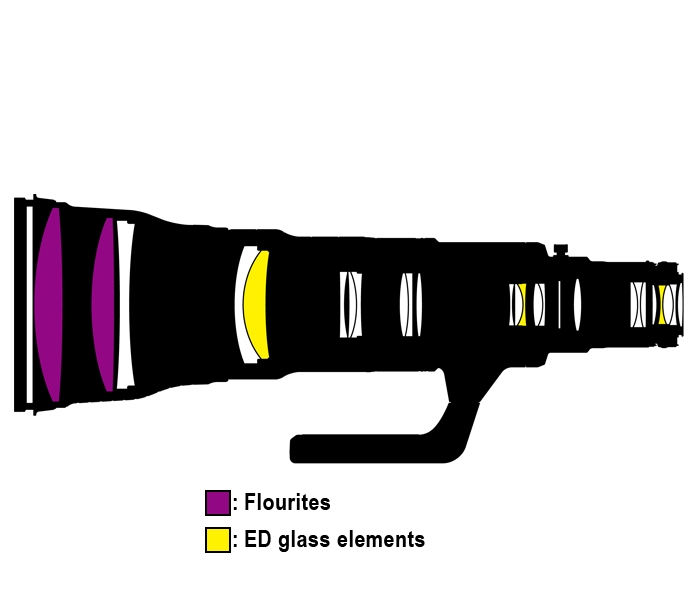
ED (Extra-Low Dispersion) Glass
An optical glass developed by Nikon that is used with normal optical glass in telephoto lenses to obtain optimum correction of chromatic aberrations.

Silent Wave Motor
AF-S NIKKOR lenses feature Nikon’s Silent Wave Motor (SWM). This technology converts “traveling waves” into rotational energy to focus the optics. This enables high-speed autofocusing that's extremely accurate and super quiet.

M/A
Select NIKKOR lenses have a focusing mode which allows switching from automatic to manual focusing with virtually no lag time by simply turning the focusing ring on the lens. This makes it possible to seamlessly switch to fine manual focusing while looking through the viewfinder.

IF Lens
A NIKKOR lens in which only the internal lens group shifts during focusing. Thus, IF NIKKORS do not change in size during AF operation, allowing for compact, lightweight lenses capable of closer focusing distances. These lenses will be designated with the abbreviation IF on the lens barrel.

Nano Crystal Coat
An anti-reflective coating developed by Nikon that virtually eliminates internal lens element reflections across a wide range of wavelengths. Nano Crystal Coat uses ultrafine, nano-sized* crystal particles to eliminate reflections inside the lens throughout the spectrum of visible light waves (380 to 780 nm) in ways that far exceed the limits of conventional antireflection coating systems. Nano Crystal Coat not only solves ghost effects caused by red light, which was incredibly difficult for previous systems. It also effectively reduces ghost and flare effects caused by light entering the lens diagonally. The result: clearer images.

Super Integrated Coating
Nikon Super Integrated Coating is Nikon's term for its multilayer coating of the optical elements in NIKKOR lenses.

Fluorite Lens Element
Fluorite (FL), a lightweight mono-crystal optical material, has excellent optical properties while reducing overall lens weight to improve balance and handling, especially useful in longer focal length lenses.

Electromagnetic Diaphragm Mechanism
An electromagnetic diaphragm mechanism in the lens barrel provides highly accurate electronic diaphragm or aperture blade control when using auto exposure during continuous shooting. With conventional D/G type lenses, the diaphragm blades are operated by mechanical linkage levers.
*Based on CIPA Standard. This value is achieved when: FX-format compatible lenses are attached to an FX-format digital SLR camera.
The lens incorporates an electromagnetic diaphragm mechanism. The following cameras are compatible with this lens:
D5, D4 series, D3 series, Df, D850, D810, D810A, D800 series, D750, D700, D610, D600, D500, D300 series, D7500, D7200, D7100, D7000, D5600, D5500, D5300, D5200, D5100, D5000, D3400, D3300, D3200, D3100, Nikon 1 J1, J2, J3, J4, J5 with FT-1, Nikon 1 V1, V2, V3 with FT-1, Nikon 1 S1, S2 with FT-1
LCD, Video and Photo Gallery images are for illustrative purposes only
Tech Specs
Focal Length
800mm
Maximum Aperture
f/5.6Format
FX
VR (Vibration Reduction) Image Stabilization
YesNano Crystal Coat
Yes
AF-S (Silent Wave Motor)
Yes
Approx. Dimensions (Diameter x Length)
6.3 in.160 mmx18.2 in.461 mm
Approx. Weight
161.6 oz. (4590 g)
- Mount TypeNikon F-Bayonet
- Focal Length800mm
- Maximum Aperturef/5.6
- Minimum Aperturef/32
- FormatFX
- Maximum Angle of View (DX-format)2°
- Minimum Angle of View (DX-format)2°
- Maximum Angle of View (FX-format)3°10'
- Minimum Angle of View (FX-format)3°10'
- Maximum Reproduction Ratio0.151xx
- Lens Constructions Elements20
- Lens Construction Groups13
- Compatible Format(s)FX, DX, 35mm Film
- VR (Vibration Reduction) Image StabilizationYes
- Diaphragm Blades9
- Distance InformationYes
- Nano Crystal CoatYes
- ED Glass Elements2
- Super Integrated CoatingYes
- AutofocusYes
- AF-S (Silent Wave Motor)Yes
- Internal FocusingYes
- Minimum Focus Distance19.36 ft.(5.9m)
- Focus ModeAuto, Manual, Manual/Auto, Auto/Manual
- E-typeYes
- Filter Size52mm
- Accepts Filter TypeSlip-in
- Compatible with Nikon AF-S TeleconvertersYes
- Approx. Dimensions (Diameter x Length)6.3 in.160 mmx18.2 in.461 mm
- Approx. Weight161.6 oz. (4590 g)
- Lens TypePrime
Product Forum
Support
Product Registration
Registering your Nikon product allows us to send you (with your permission) important updates, service information and helpful hints, and it makes it easier should you ever need to call in for help.
Register your product online now.Nikon Answers Site
We store all resolved problems in our solution database. If you can’t find a relevant answer, feel free to submit a question to our technical support team.
View Questions & Answers